Reversible Programming Primer: Symmetry-Breaking (Part 2)
In part 1 of the discussion of symmetry-breaking, we discussed what symmetry-breaking was, the motivating problems that necessitated the introduction of symmetry-breaking, and many of the basic primitives that can be used to build symmetry-breaking code. However, we were left with an unwieldy tool that broke all of the patterns that we had previously established. In this sixth post on reversible programming, we will discuss the problems that symmetry-breaking has left us with, a more precise model of how reversible functions can be structured, and a substitute for undo symmetry that can salvage our existing patterns for use in symmetry-breaking code.
A Disclaimer on Syntax
The code examples in this series use C-like imperative pseudocode. New reversible programming primitives will be given distinct syntax and keywords from the non-reversible primitives that they displace, even if their functionality is nearly identical, because the existing non-reversible primitives are still used throughout these posts to provide contrasting examples or to make the behavior of reversible primitives explicit by giving concrete implementations.
This syntax is also distinct from the syntax of existing reversible programming languages, which often choose to reuse the syntax and keywords of non-reversible programming languages for corresponding-but-not-equivalent concepts.
Cleaning Up After Symmetry-Breaking Functions
In the previous post, we discovered that all of the functions we had been dealing with up to that point in the series had a property called “undo symmetry”, and this symmetry was the source of a lot of those functions’ nice properties. One of the most important properties of undo symmetric functions is that we can clean up the results of running an undo symmetric function by just running it a second time in reverse.
In some special cases, such as the forward_half_toggle and reverse_half_toggle
discussed in the previous post,
symmetry-breaking functions can have similarly simple cleanup methods. For
forward_half_toggle and reverse_half_toggle, we can clean up their results
by just running them a second time in the same direction. However, in the
general case of symmetry-breaking code, cleaning up after the results of running
the code is much less straightforward.
For example, consider the following code snippet:
fdo {
  list.push("Executed forward");
}
rdo {
  // Remember from the last post, that we can wrap the contents of an `rdo`
  // block in `undo` to make it execute as-written when code is executed
  // in-reverse.
  undo {
    list.push("Executed reverse");
  }
}
Regardless of the direction this code snippet is executed, it results in a value
being pushed into list. Run as-is, it pushes the string "Executed forward".
But if we were to run it in an undo block:
undo {
  fdo {
    list.push("Executed forward");
  }
  rdo {
    undo {
      list.push("Executed reverse");
    }
  }
}
it would push the string "Executed reverse".
In this case, we can just look at the code and easily deduce how to clean up
after it. We can trivially just swap the undo into the other block, and
execute that:
fdo {
  undo {
    list.push("Executed forward");
  }
}
rdo {
  list.push("Executed reverse");
}
However, we won’t always have the ability to inspect the implementation of code like this; often we will be invoking code by calling a function and may not have access to the function’s definition. Plus, we ideally do not want to have to manually invert each piece of code to clean it up. The ability to automatically clean up after arbitrary code was what made Lecerf-Bennett Reversal so important, after all.
Moreover, the motivating example for symmetry-breaking, reading user input, is an example of a type of code that outputs a result that we simply cannot clean up at all, by the nature of reversible programming languages.
This code example is a bit contrived, but it raises the question of how difficult it will actually be to wrangle examples of symmetry-breaking code encountered “in the wild”, in external dependencies that the programmer doesn’t have control over or the ability to examine the source code of. If symmetry-breaking breaks all of our patterns, then are there any new patterns that we can rely on to make symmetry-breaking comprehensible? And without undo symmetry, what is even our foundation for the behavior of reversible code?
Up until this point, undo symmetry served as the intuitive litmus test for whether or not code was reversible, even though we didn’t really recognize that the symmetry even existed until after we had already broken it. Without being able to run code backwards to “undo” it, it’s a little harder to feel sure that what’s happening in the code is reversible. What we really need is a new way of reasoning about what kinds of patterns are actually possible in reversible code.
Bifunctions
With fdo and rdo, we have basically reached a point where the behavior of a
function can be broken into two entirely independent functions defining its
forward and reverse behaviors. We can write this kind of code in a fully general
form as follows:
fdo {
  f();
}
rdo {
  // For simplicity, we'll wrap the body in `undo` so that it executes
  // as-written.
  undo {
    r();
  }
}
Here, f and r are the independent forward and reverse behaviors of the
function. When this snippet is executed forward, f() is called, and when it is
executed in reverse, r() is called.
Writing out this entire sequence of nested control structures with function
calls in them is a little cumbersome. In this section, we are going to be making
a lot of statements about this structure and giving a lot of examples, so, just
for this section, it would be helpful to adopt a more concise shorthand. In the
examples that follow, we will represent a code snippet that runs f when
executed forward and r when executed in reverse as:
Since our code snippet is really composed of two different functions, it might make more sense to think of it as something other than a function. We might think of it as a “bifunction” instead, since it’s made up of a pair of functions.
We can call a bifunction, which just results in the first function in the pair being called:
\[[f, r]() = f()\]This is equivalent to running the above code snippet forward, as both just
result in a call to f().
If we want to be able to call r(), we can “reverse” the bifunction, which
swaps the two bifunctions in the pair:
This uses the “transposition” syntax,
since it is literally “transposing” (or “swapping”) the two functions.
Transposing the bifunction is equivalent to wrapping the entire code snippet in
an undo statement:
undo {
  fdo {
    f();
  }
  rdo {
    undo {
      r();
    }
  }
}
If we want to call r(), we can transpose the bifunction and then call it,
which is equivalent to wrapping the structure in an undo block then executing
it forward:
But, when we talk about “cleanup”, what we really want are the “inverses” of f
and r. For the sake of discussion, we can represent this “true inverse” of a
bifunction as:
Inverting a bifunction replaces each of its constituent functions with their inverses. This produces a new bifunction where each direction truly “undoes” the results of one of the directions of the original bifunction. This operation is not available in reversible programming languages, but it’s useful to be able to clearly represent the inverse.
So, how can we make sense of these two different forms of “inversion”? As with previous difficult control flow concepts, it might be helpful to return to the railroad analogies that we’ve used previously.
Executing \(f\) would be equivalent to traveling in one direction down the track:
\[[f, r]()\]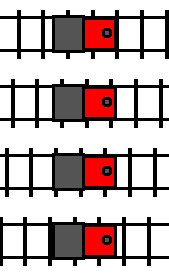
Executing \(r\) by transposing the bifunction would be equivalent to traveling in the opposite direction down the same track, which takes you in the opposite direction:
\[[f, r]^T()\]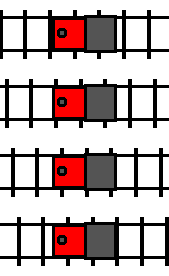
This is clearly going in the opposite direction, and if the train was hauling back the same cargo, it might even be accomplishing the inverse of the train headed right, but is clearly not being “rewound”, as the train is facing the opposite direction.
On the other hand, executing the inverse of \(f\) by inverting the bifunction, which truly undoes the behavior of \(f\), would be equivalent to backing up along the track, backing away from the destination that was reached by traveling forward.
\[[f, r]^{-1}()\]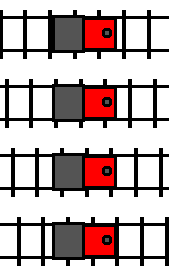
This is a “true rewind” of the behavior of \([f, r]()\).
And finally, we can combine the two, and execute the inverse of \(r\) by both transposing and inverting the bifunction, which truly undoes the behavior of \(r\). This would be equivalent to backing away from the destination that was reached by traveling in in the opposite direction.
\[[f, r]^{-T}()\]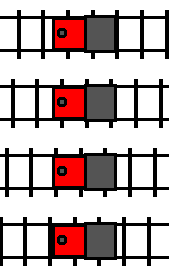
Ordinary non-reversible code can only be executed in one direction, and the pitch for reversible code is that the code can be executed in two directions, which are generally suggested to be \([f, r]\) and \([f, r]^{-1}\). However, we’ve just described four different “directions” of reversible code execution (if we can stretch the definition of “direction” a bit).
With this four “direction” model, it becomes clear, that reversible programs only have access to \([f, r]\) and \([f, r]^{T}\), while the “backing up”/”rewind” directions, \([f, r]^{-1}\) and \([f, r]^{-T}\), are not accessible during normal code execution, even though their behavior is well-defined. The reason for this mismatch is because of the implicit assumption baked into most discussions of reversible computing that all reversible code is undo symmetric. Under this model, undo symmetric code can be always be written as a bifunction of the form:
\[[f, f^{-1}]\]In other words, undo symmetric bifunctions have the property that the two functions that make up the bifunction are inverses of one another. As a result, transposition and inversion are equivalent when applied to undo symmetric bifunctions:
\[\begin{align*} [f, f^{-1}]^T &= [f^{-1}, f] \\ [f, f^{-1}]^{-1} &= [f^{-1}, f] \end{align*}\]As a result, if you were not aware that reversible bifunctions existed that were not undo symmetric, you would be under the impression that inversion was readily available, because you would think that transposition and inversion were simply the same thing.
But, there’s one remaining question for this model. If you remember from the previous post, we determined that the inverse of reading user input cannot exist in a reversible programming language, and this is why reading user input cannot be undo symmetric. In other words, for a \(readline\) function that reads user input, we cannot construct a bifunction \([readline, readline^{-1}]\). This means that there are restrictions on what kinds of functions are allowed to be part of a reversible bifunction.
If that restriction excludes I/O functions (or any other functions that are necessary for practical user-facing applications), then we’re going to have difficulty accomplishing much of value in a reversible programming language.
Luckily, the constraint turns out to be fairly flexible, and offers enough wiggle room for I/O and other important features: we just need these functions to be backward deterministic.
Forward and Backward Determinism
It’s typical to think of the functions or instructions of a reversible programming language as injective functions over program states, that map in a 1:1 fashion from an input program state to an output program state. If we restrict ourselves to injective functions only, then reading user input is forbidden from the outset, because reading user input is non-injective; it maps a single initial input state to one of several possible resulting output states depending on what the user’s input actually was. Luckily, we can make our criteria more lenient, by breaking “injectivity” down further into two constituent properties: “forward determinism” and “backward determinism”.
- A function is “forward deterministic” if, for each input, there is exactly one possible output (In true mathematical terms, functions that violate forward determinism are instead called “relations”, but we’ll continue to call them “functions”, because the idea of things like “random functions” that return one of several results non-deterministically is well understood in computer programming).
- A function is “backward deterministic” if, for each possible output, there is exactly one possible input that can produce that output.
A function that is both forward deterministic and backward deterministic must also be injective, because if each input can only produce one output, and each output can only be produced by one input, the function must be a 1:1 mapping. This slots forward and backward determinism into the bottom level of the hierarchy of properties that make up “bijectivity”:
graph BT
    FwdDet["Forward Deterministic"]
    BwdDet["Backward Deterministic"]
    Injective
    Surjective
    Bijective

    Injective --> Bijective
    Surjective --> Bijective
    FwdDet --> Injective
    BwdDet --> Injective
For the purpose of our bifunction model, our only criteria is that the two members of a bifunction must each be individually backward deterministic. Backward determinism is the minimum possible requirement for a function \(f\), that ensures that \(f^{-1}(f(x)) = x\); in other words, it is the minimum property that ensures that, given the result of evaluating a function, it is always possible to recover the original input prior to the function being evaluated. This is because, if \(f\) is a backward deterministic function, then \(f^{-1}\) must be a forward deterministic function that maps all of the possible outputs of \(f\) back to the initial input that produced them. The fact that there is always a way to retrieve the initial input state that produced each output state means that no information is being lost.
Note that the ordering of the composition above is specific, and does not necessarily work the other way. It is not necessarily true for a given backward deterministic function \(f\) that \(f(f^{-1}(x)) = x\) in all cases. For a common example from the world of mathematics, just consider squaring a number, and its inverse, taking the square root. Let’s define a squaring function, \(square(x) = x^{2}\), with its inverse being the well-known square root: \(sqrt(x)\). \(sqrt(x)\) is a backward deterministic function, and thus it is always true that \(square(sqrt(x)) = x\). However, it is not always true that \(sqrt(square(x)) = x\). For example, when \(x = -2\).
\[sqrt(square(-2)) = sqrt(4) = 2\]As you may have guessed, reading user input (or any other form of I/O, for that matter) is not forward deterministic, because it can produce multiple possible values, but it is backward deterministic, or at least, you can specify I/O primitives in a backward deterministic way. For example, we can return to that original motivating example for symmetry-breaking:
string text <- readline();
This statement for reading user input can be specified as a bifunction,
\([readline, r]\), where readline and r are each independent backward
deterministic functions.
The fact that readline is backward deterministic but not forward deterministic
confirms our reasoning in the previous post that the inverse of readline does
not exist in reversible programming languages, and that the output of readline
cannot be cleaned up. However, this critical distinction between injective
functions and backward deterministic functions also provides the seam that we
can use to get ahold of and wrangle a huge and useful subset of
symmetry-breaking code.
It is true that functions that lack forward determinism, like readline can
only be exposed to reversible programming languages as symmetry-breaking
bifunctions. However, the inverse is not true. It is not true that every
symmetry-breaking bifunction is composed of individual functions that lack
forward determinism. By exploiting the fact that most symmetry-breaking
primitives do have forward determinism and can be undone, we can develop
a new kind of pattern for writing symmetry-breaking code that makes it
significantly easier to work with.
Undo Pseudosymmetry
As discussed in the first section,
symmetry-breaking code does not play nicely with the patterns we’ve introduced
in past posts for cleaning up after running code. We could not safely include
symmetry-breaking code in a flash block,
for example, because flash blocks and other cleanup methods implicitly assume
that the code being cleaned up possesses undo symmetry.
But, what if it were possible to have our cake and eat it too? What if we could
write code that broke undo symmetry, allowing it to accomplish totally new
things that cannot be accomplished without breaking undo symmetry, but that code
was also cleverly disguised so that from the perspective of things like flash
blocks, it seemed to behave as if it had undo symmetry?
In the section about undo symmetry, undo symmetry was
informally defined as a property of any function f for which the following
program:
f();
undo {
  f();
}
Results in no net change to the program state.
So, returning to the question from above: is it possible for code that internally breaks symmetry to have this property?
The answer is: yes.
In the previous post,
we discussed how forward_half_toggle and reverse_half_toggle together make a
“whole” toggle.
forward_half_toggle(&boolean_variable);
reverse_half_toggle(&boolean_variable);

// Is equivalent to:

!@boolean_variable;
Since toggling a boolean is undo symmetric, this sequence of half-toggles satisfies the undo symmetry property:
// This pair toggles the boolean when executed forward.
forward_half_toggle(&boolean_variable);
reverse_half_toggle(&boolean_variable);
undo {
  // This pair toggles the boolean back to its initial value when executed in reverse.
  forward_half_toggle(&boolean_variable);
  reverse_half_toggle(&boolean_variable);
}
So, there is definitely code that internally breaks symmetry, but behaves as if it had undo symmetry. We could say that such code has “undo pseudosymmetry”; if its individual operations were carefully observed, it would be clear that the code is actually doing different things when run forward or in reverse, but at the granularity of the entire code snippet, the code performs the exact inverse behavior when run in reverse.
However, this is obviously an extremely trivial example. Using symmetry-breaking primitives to implement existing undo symmetric primitives doesn’t allow you to do anything new. But, as it turns out, there are non-trivial code structures that internally break symmetry to accomplish things that could not be accomplished without breaking symmetry, that nonetheless have undo pseudosymmetry.
clutch
In a previous post on backtracking, we examined an application of backtracking as a form of error handling, where errors were handled by toggling an error flag and initiating backtracking.
bool error_encountered <- false;
bool handling_error <- false;

// On our first pass, this `given` statement will be skipped.
given(error_encountered) {
  // This toggle reflector terminates the backtracking
  // initiated by the error condition later in the program
  // and sets the `handling_error` flag.
  turn(handling_error) {
    !@handling_error;
  }
}

// Pre-backtracking we enter the `do_some_work` block.
// Post-backtracking, we enter the `handle_error` block.
given(!handling_error) {
  do_some_work();

  // Whoops, we encountered an error. Let's set the
  // `error_encountered` flag and initiate backtracking.
  given(some_error_condition) {
    turn(error_encountered) {
      !@error_encountered;
    }
  }
} else {
  handle_error();
}
Here, when an error occurs, we flip the error_encountered flag and initiate
backtracking. The guard statement prior to the erroring code is able to detect
this error flag and recover from the backtracking.
This is all well and good as long as you know ahead of time exactly what error flags the code you are calling into is going to set. However, what if you know that the code might initiate backtracking, but you do not know, or do not have access to, the error flags that the code is going to set? It seems like interrupting the backtracking would become impossible.
This is where a new control structure can come in clutch: the clutch
statement.
We can implement the clutch statement as follows:
clutch(&condition_variable) {
  // body
}

// Is equivalent to:

bool temp -< condition_variable;
turn(temp) {
  reverse_half_toggle(&temp);

  // body

  reverse_half_toggle(&temp);
}
temp >- condition_variable;
temp here is a hidden temporary variable that only the clutch statement can
access. Unlike the control structures introduced in previous posts, clutch
does not accept a condition expression, and instead accepts a reference (&)
to a condition_variable.
With both turn statements and symmetry-breaking in its implementation, the
clutch statement may seem intimidating, but its behavior is actually pretty
simple.
- Like a
turnstatement, theclutchstatement initially begins executing its block forward ifcondition_variableisfalse, and in reverse ifcondition_variableistrue. - However, when the
clutchstatement exits, code always resumes executing in the same direction it was executing before theclutchstatement began, regardless of what direction the block was executed and whether or not the block initiated backtracking. - However, if the block initiated backtracking and exited in the opposite of the
direction it was entered, the
condition_variablewill be toggled when theclutchstatement completes.
clutch acts kind of like a “sandbox” for backtracking; it prevents
backtracking from leaking out of the clutch statement’s block into the rest of
the program. Reversibility is maintained because the information about whether
or not backtracking occurred is persisted in the toggling of the boolean.
In past posts,
it has been helpful to use railroad analogies to help understand how some of the
more complex control structures work, and there’s a pretty clean visual analogy
for a clutch statement, although it’s a little more exotic than the previous
railway analogies.
A clutch statement is essentially equivalent to a turntable that automatically
rotates to ensure that the train’s absolute orientation remains the same at all
times while it is on the turntable. Because the train’s orientation remains
constant, it is obvious that, regardless of what path it takes, the train must
exit on the opposite side of the turntable going forward.
Once the train leaves the turntable, the turntable is left in the exact same
state that it was in when the train rolled off, which is reflective of the
boolean condition_variable being toggled if the clutch statement block exits
in the opposite direction it was entered (though, in the animation above, for
the sake of looping, it flips back to the original side for the next iteration
of the animation).
Just as the “clutch” in a car disengages the engine from the transmission,
allowing them to rotate independently, the “clutch statement” disengages the
control flow within its block from the control flow of the program outside the
block, allowing the block to change direction independently of the rest of the
program.
With clutch, we can catch a wide range of errors at the same time without
needing to individually check the error flags for each of those errors:
bool backtracking_occurred <- false;

clutch(&backtracking_occurred) {
  // Backtracking can be initiated with any one of several error flags:
  given(condition_a) {
    turn(flag_a) {
      !@flag_a;
    }
  }

  given(condition_b) {
    turn(flag_b) {
      !@flag_b;
    }
  }

  given(condition_c) {
    turn(flag_c) {
      !@flag_c;
    }
  }
}
// `backtracking_occurred` will be toggled to `true` if backtracking occurred
// with *any* error flag.

given(backtracking_occurred) {
  perform_some_generic_error_recovery_procedure();
}
When the clutch body initiates backtracking, the clutch statement
“sandboxes” the backtracking and prevents it from propagating. Instead of
continuing to backtrack, the program instead proceeds onward to the following
given statement. Since the clutch statement will toggle the
backtracking_occurred flag when it recovers from backtracking, the given
statement will be entered and the cleanup code will be executed.
clutch can be used if you don’t need to respond to the specific details of the
error, but you do need to run some sort of generic cleanup operation in any
circumstance where a particular code block raises an error.
Pseudosymmetry of clutch
The clutch statement solves a novel problem, but is it really pseudosymmetric?
Let’s think about what causes code to break symmetry in the first place.
Symmetry-breaking code is code that allows you to detect the direction that code
execution is moving. forward_half_toggle and reverse_half_toggle break
symmetry because they effectively assign each direction a value, 0 or 1, and
XOR that value into a boolean, and this assignment of a value to each
direction allows them to be distinguished. However, clutch’s behavior is not
defined in terms of execution moving in one direction or another. It is purely
defined on the basis of whether or not the direction of execution changed.
This is an event that is independent of what the initial or final direction
were, and thus doesn’t require assigning either direction any distinguishable
characteristics.
This can probably be most clearly seen in the fact that there is an exactly
equivalent implementation of the clutch statement that replaces all of the
reverse_half_toggles with forward_half_toggles.
clutch(&condition_variable) {
  // body
}

// Is equivalent to:

bool temp -< condition_variable;
turn(temp) {
  reverse_half_toggle(&temp);

  // body

  reverse_half_toggle(&temp);
}
temp >- condition_variable;

// Is *also* equivalent to:

bool temp -< condition_variable;
turn(temp) {
  forward_half_toggle(&temp);

  // body

  forward_half_toggle(&temp);
}
temp >- condition_variable;
Assuming that the conditions discussed for the clutch’s implementation are
observed (that the code inside of the body is not allowed to access the temp
variable), it is not possible to distinguish the behavior of these two
implementations.
It’s also possible to perfectly emulate the behavior of a clutch statement
without using symmetry-breaking instructions, but only by modifying all of the
locations within the block passed to the clutch statement that potentially
initiate backtracking.
bool backtracking_occurred <- false;

clutch(&backtracking_occurred) {
  given(condition_a) {
    turn(flag_a) {
      !@flag_a;
    }
  }

  given(condition_b) {
    turn(flag_b) {
      !@flag_b;
    }
  }

  given(condition_c) {
    turn(flag_c) {
      !@flag_c;
    }
  }
}

// Is equivalent to:

bool backtracking_occurred <- false;

turn(backtracking_occurred) {
  given(condition_a) {
    turn(flag_a) {
      !@flag_a;
      !@backtracking_occurred;
    }
  }

  given(condition_b) {
    turn(flag_b) {
      !@flag_b;
      !@backtracking_occurred;
    }
  }

  given(condition_c) {
    turn(flag_c) {
      !@flag_c;
      !@backtracking_occurred;
    }
  }
}
Here, rather than implicitly detecting whether or not backtracking occurred
using a symmetry-breaking primitive, we have each instance of backtracking
directly inform our simulated clutch statement that backtracking has occurred
by manually flipping the backtracking_occurred variable. This is similar to
the method provided for emulating symmetry-breaking in an
extra section of the previous post,
but it differs in that the duration for which the proxy direction bit needs to
be tracked is scoped to only the duration of the clutch statement’s execution,
rather than needing to be maintained at every direction reversal in the entire
program.
In theory, clutch could be implemented as a sort of “macro” that rewrites
its block in this fashion, and the resulting rewritten code would not break
symmetry at all. However, such a macro would be fairly complex, because it would
also have to recursively write a new “signaling” version of every function that
is called from the block. The power of the clutch statement is that by
breaking symmetry, it is able to localize the concern of detecting backtracking
to only the location where you actually care about it: the place where you’re
invoking the clutch statement.
Implications of Pseudosymmetry
The upshot of pseudosymmetry is that clutch statements or other
pseudosymmetric code structures can be mixed in with ordinary undo symmetric
code under the patterns that we have been using up until now without issues.
Every pattern that symmetry-breaking destroys, pseudosymmetry restores.
As long as the contents of the clutch statement do not break undo symmetry
(or, are at least pseudosymmetric themselves), you can feel safe calling a
clutch statement in a flash block, or executing it backwards, sideways,
upside-down, what have you.
flash {
  bool error_occurred <- false;
  // the `error_occurred` flag preserves the information about how backtracking
  // should flow backwards through the `clutch` statement.
  clutch(&error_occurred) {
    some_func();
  }

  expose {
    given(error_occurred) {
      handle_error_result();
    } else {
      success_result();
    }
  }
}
This captures the general pattern of how symmetry-breaking can be used in a reversible programming language without introducing complete chaos to the lives of all programmers using the language. Even if a function or API internally breaks symmetry, externally, that symmetry-breaking can be wrapped in an easy-to-handle pseudosymmetric interface. In future posts, we will explore how pseudosymmetry can be used to make the underlying implementations of some algorithms more performant, how it can be used to sand the edges off of I/O primitives and make them function in a more pseudosymmetric fashion themselves, and the various trade-offs for each of these approaches.
Wrapping Up
Symmetry-breaking is not typically something that you would want to see exposed in a user-facing API. But in the implementation of many such APIs, the concepts discussed in this post are the first tools in your toolbelt for wrapping symmetry-breaking implementations in pseudosymmetric packages that can be safely exposed to an end user.
The best of pseudosymmetry is yet to come, but before we get there, we’ll need to take a detour through some of the more nuts and bolts aspects of how code execution happens in a reversible programming language. In the next few posts in this series, we will be looking at the way in which nested expressions are evaluated, and the way in which functions are defined and called.
Extra: Multiple Levels of Symmetry and Symmetry-Breaking
As long as we use backward deterministic functions, we guarantee that our code’s execution could be rewound in theory. However, the consequence of downgrading our constraint from injectivity to backward determinism is that a running program cannot always manually rewind the execution of code by running it backwards. If the code contains symmetry-breaking primitives, then this would cause the code to deviate from the behavior of a true rewind (by design). But, maybe we could preserve this ability to manually rewind code, even when symmetry-breaking code is used.
In an extra section of the previous post, we examined how it was possible to simulate symmetry-breaking by maintaining a global “proxy direction bit” that got toggled each time the direction of execution reversed. We could then break symmetry by reading from the proxy direction bit with a XOR. However, what if we reversed execution without toggling the proxy direction bit?
Since the proxy direction bit that is used to break symmetry was not toggled, the program would actually rewind precisely, just as it would if we had not broken symmetry at all, since all of the operations that read the proxy direction bit would now read an inverted value relative to the actual direction of execution. This essentially gives us access to all four “directions” discussed in the main article above:
| “Direction” | Execution Direction | Proxy Direction Bit |
|---|---|---|
| \([f, r]\) | Forward | Forward |
| \([f, r]^{T}\) | Reverse | Reverse |
| \([f, r]^{-1}\) | Reverse | Forward |
| \([f, r]^{-T}\) | Forward | Reverse |
(At least, with respect to all of our algorithmic code. Any I/O code is still going to be have its “transposition” called instead of its “inverse”.)
However, this raises an interesting idea: what if reversible computer hardware included a “proxy” direction bit in addition to the real one? One of them would control the direction of execution, and the other would control the behavior of symmetry-breaking instructions.
Normally, when we reverse execution, we would toggle both bits together. However, if we wanted to initiate true backtracking that overrides symmetry-breaking, we could toggle the true direction bit without toggling the proxy direction bit. In this way, we could implement true rewind, even in a language with symmetry-breaking (again, excluding I/O operations, which might blow up if not properly-handled).
To be clear, we still cannot access the “real” true rewind, so what we’ve really done is basically created a sort of emulator that adds a simulated true rewind at a software level. Essentially, we now have 8 “directions” instead of 4, with 4 of those being inaccessible “real” true rewind “directions”. But, as long as we can do this, we may as well keep going. We could introduce any number of different simulated “levels” of symmetry-breaking that each have an associated proxy direction bit.
When it comes to building a reversible instruction set, it could make sense to make reading the true direction bit, or toggling it in isolation, a privileged operation, so that the operating system would maintain the ability to perfectly rewind any executing process if necessary, and user-level symmetry-breaking would instead use one of the secondary direction bits that are always toggled in tandem with the direction bit in non-privileged code.
Extra: More on Bifunctions & 6 Basic Symmetry Categories
There are a few additional interesting things to go over with the bifunction syntax introduced in an earlier section.
Firstly, I couldn’t find a natural place to squeeze it in in the main section, but bifunctions have a composition rule:
\[[f, r] \circ [a, b] = [f \circ a, b \circ r] \\\]Composing a bifunction composes the first functions from the pairs in the normal order, and composes the second functions from the pairs in reverse order. Composing the second elements of the pairs in reverse order is necessary for maintaining the “socks and shoes principle of inversion” with respect to both the inversion and transposition operations:
\[\begin{align*} ([f, r] \circ [a, b])^T &= [a, b]^T \circ [f, r]^T \\ ([f, r] \circ [a, b])^{-1} &= [a, b]^{-1} \circ [f, r]^{-1} \\ \end{align*}\]The “socks and shoes principle” states that the inverse of the composition of two functions is the composition of the inverses of those functions, composed in the opposite order.
And secondly, bifunctions can actually have a few more basic kinds of symmetries beyond just undo symmetry. If we consider different combinations of the relationships between the two functions that make up a bifunction, and the potential self-inverseness of those functions, we can identify a few of these.
Here, we will use the syntax \(f^{-1}\) for the inverse of the function \(f\), and the syntax \(\hat{f}\) to represent the function \(f\) if that function is its own inverse.
It turns out that we can find 6 basic types of symmetry, which I’ve given the following names:
- \([f, f]\) - Gyro Symmetric (both directions of execution have the same behavior)
- \([f, f^{-1}]\) - Undo Symmetric (the directions of execution have inverse behaviors)
- \([\hat{f}, r]\) - Forward Involution (the forward direction of execution is self-inverse)
- \([f, \hat{r}]\) - Reverse Involution (the reverse direction of execution is self-inverse)
- \([\hat{f}, \hat{r}]\) - Redo Symmetric (both directions of execution are self-inverse)
- \([\hat{f}, \hat{f}]\) - Involution (both directions of execution have the same self-inverse behavior)
Certain symmetries imply other types of symmetries. In the following graph, if a function has a particular symmetry, then it also has all of the symmetries that are pointed at by that symmetry.
graph TB
    UndoSymmetric["Undo Symmetric"]
    RedoSymmetric["Redo Symmetric"]
    ForwardInvolution["Forward Involution"]
    ReverseInvolution["Reverse Involution"]
    GyroSymmetric["Gyro Symmetric"]
    Involution

    Involution --> UndoSymmetric
    Involution --> RedoSymmetric
    Involution --> GyroSymmetric
    RedoSymmetric --> ForwardInvolution
    RedoSymmetric --> ReverseInvolution
We also have some inference rules in the other direction. If a function is both a forward involution and a Reverse involution, then it has redo symmetry. If it possesses any other combination of two of these symmetries, then it must possess all six.
Of these six, undo symmetry and redo symmetry are of the greatest interest, because these are the two types of symmetries in which the inverses of both functions in the bifunction are available simply by calling the bifunction in one direction or the other. In undo symmetry, the two functions are inverses, meaning you can “undo” a function by evaluating it backward, and in redo symmetry each function is its own inverse, meaning you can “undo” a function by evaluating it again, or “redoing” it.